

Chapter 2: The Greatest Threat to American Sovereignty

Updated: Jan 13
A new existential threat to the very existence of the United States of America has emerged. It is not atomic bombs, or a space race, or even fiat currencies. The latest threat is the race for AI supremacy. The winner of this race will subjugate and control all other nations, to an extent inconceivable even a decade ago.
"The supreme art of war is to subdue the enemy without fighting.", Sun Tzu (544–496 BC)

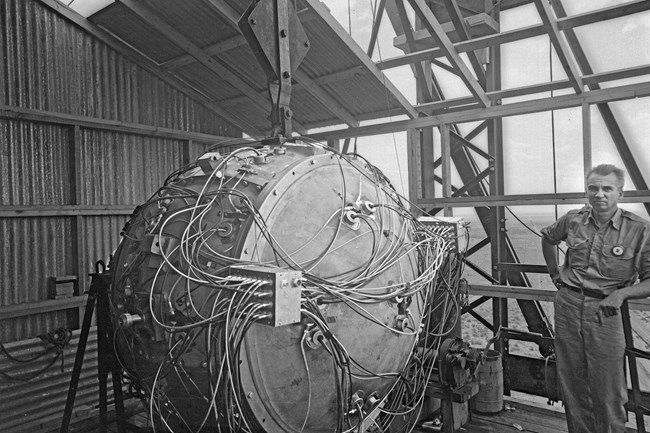
The race for AI supremacy can be viewed similarly to America's WW2 race for the first atomic bomb.
Key Points:
1. In 2025, the greatest threat to American sovereignty is the race for AI supremacy, currently a two-horse race between the US and China.
2. The United States must achieve AI supremacy, or face catastrophic consequences.
3. The winner of this race will dominate the world for decades, probably generations, to come.
The Problem: Whoever achieves true AI supremacy will instantly possess near-insurmountable advantages in every facet of geopolitics.
The Modern Battlefield Has Evolved
Power has always been the currency of sovereignty. For centuries, nations measured it in land, armies, and gold. In the twentieth century, they measured it in oil. In the twenty-first, power is measured in computation.
We now live in a world where data is territory, algorithms are artillery, and the ability to compute is the single greatest determinant of influence on Earth.
Every major nation understands this, though few say it out loud. The race for artificial intelligence is not about convenience or consumer tools. It is about survival. It is about who governs the digital nervous system that will soon control everything from economies to defense systems.
Whichever nation wins the AI race will command not just technology but the infrastructure of human progress itself.
And yet, beneath the headlines, the speeches, and the political posturing, there is a truth so simple and so dangerous that it has gone largely unspoken.
This new arms race—the race for intelligence—is in fact the race for electrons.
Because intelligence now runs on electricity.
No matter how many GPUs a nation buys, how many chips it manufactures, or how many data scientists it trains, none of it matters without power.
Without electrons, there is no algorithm. Without electricity, there is no sovereignty.
Government Policy, Progress Over Philosophy
In Washington, policymakers talk about AI as though it were a philosophical debate or an ethical dilemma. It is neither. It is a matter of capacity. The winner of this race will not be the nation with the best intentions or the most regulations. It will be the nation that can produce and deliver the most consistent, cheapest, and most reliable power to its compute infrastructure.
Right now, the United States is losing that race.

The American grid is old, slow, and saturated. The Department of Energy estimates that over one trillion dollars in deferred maintenance now burdens its arteries. Transmission upgrades take decades. Permitting processes drag on for years. New nuclear projects, even small modular reactors, are a decade away from meaningful scale.
Meanwhile, demand for computation is exploding at a rate that outpaces everything built before it.
This mismatch between ambition and infrastructure is not theoretical. It is mathematical. The curves do not intersect.
By 2028, AI workloads alone could consume up to nine percent of total U.S. electricity generation. That is more than some nations consume altogether. And the load is growing faster than new generation can be built.
If America cannot energize its data centers, it will lose its technological advantage.
And if it loses that advantage, it will lose the one thing no superpower can survive without—control.
History provides a brutal reminder of what happens when a nation falls behind in the race for power.

In the early twentieth century, Britain ruled the seas and the colonies. But as oil began to replace coal, the British Empire hesitated. It clung to its mines and its aging steam engines while new industrial powers built fleets powered by petroleum. Within a generation, the balance of global power had shifted to those who had mastered oil—America and, later, the Middle East.
In the Cold War, the contest for nuclear technology determined who could project force without firing a shot. The country that controlled atomic energy controlled deterrence, diplomacy, and destiny.
Now, the same pattern repeats. The nations that control computational power will dominate this century.
The United States still leads, but leadership is not the same as inevitability. China has already declared artificial intelligence a cornerstone of national strategy. It has built over seven hundred data centers in the past five years and is constructing hundreds more. Its Belt and Road Initiative is not just about trade routes—it is about digital pipelines that will carry influence in the form of data and computation.
Europe, for all its bureaucracy, has begun investing heavily in renewable and nuclear generation specifically to power AI and cloud infrastructure. The Gulf states are pouring oil wealth into sovereign data hubs that will anchor their relevance long after petroleum runs out.
And the United States? It is still arguing about permits.
The nation that once built the Hoover Dam in five years and electrified the countryside in a decade now takes longer than that to approve a single transmission project. The bottleneck is not intelligence. It is willpower.
The modern battlefield is not fought on land or sea. It is fought in invisible domains—cyberspace, finance, data, and influence.
When an adversary can infiltrate an electric grid, paralyze a banking system, or weaponize an algorithm, the distinction between war and peace disappears. And the line between power and powerlessness becomes painfully thin.
Artificial intelligence amplifies this dynamic. The tools that can automate discovery, prediction, and control also automate domination. Whoever controls the compute controls the outcome.
This is why the question of power is not an economic debate. It is a national security imperative.
The same way radar and nuclear energy defined victory in the twentieth century, computational sovereignty will define victory in the twenty-first.
And here lies the danger: America’s compute expansion is not under its own control. It depends on a fragile network of utilities, permitting agencies, and grid operators. Each is a potential chokepoint. Each is vulnerable to failure, sabotage, or simply inertia.
It is a system that moves at a fraction of the speed of innovation.
In contrast, the adversaries that threaten American dominance are building vertically integrated ecosystems. They control their energy production, their transmission, their hardware manufacturing, and increasingly their compute itself.
They do not wait for permission.
If this trend continues, America will find itself in a similar position as Japan in 1947—a nation on its knees, at the mercy of its captors.
There is, however, another path.

Imagine a network of computational cells distributed across the continent, each generating its own power directly from the sun, storing it on-site, and operating continuously without dependence on the grid. Imagine a decentralized system that cannot be hacked, throttled, or delayed by bureaucracy.
That is not a dream. It already exists.
The Solar Computing Cluster is not just a technical breakthrough. It is a strategic one. It represents energy independence for the intelligence age—the same way oil represented independence for the industrial age.
A single cluster can power high-density AI workloads indefinitely. Multiple clusters can form a sovereign computing fabric capable of sustaining America’s technological leadership for generations.
The advantage is not only in cost or speed. It is in control.
Control means no dependency on foreign supply chains for critical equipment. Control means no interconnection delays that paralyze expansion. Control means the ability to scale computation faster than any adversary can respond.
Control means sovereignty.
In 1942, when Franklin Roosevelt asked General Electric to build the turbines for the Hoover Dam, he did not ask for efficiency. He asked for capacity. The world was at war, and the future was on the line. America understood then what it has forgotten now: when the future depends on infrastructure, speed is security.

We must return to that approach.
The United States cannot afford to treat electricity as a solely a commodity. It must treat it as a weapon of peace and prosperity—a force to be controlled, deployed, and defended.
The grid was built for the industrial age. It was a masterpiece for its time. But it is no longer the engine of civilization. It is the skeleton of a fading era.
The new era belongs to systems that can create power as easily as they consume it. Systems that can think, decide, and sustain themselves. Systems that are sovereign by design.
This is what the Solar Computing Cluster represents. Not a replacement for the grid, but a parallel civilization that can run on its own energy, on its own terms, at its own speed.
It is the blueprint for how America can remain the leader of the free world in a century defined not by nations, but by networks.

Sun Tzu once wrote, "The supreme art of war is to subdue the enemy without fighting."
In our time, subduing the enemy means out computing them.
And out computing them means out powering them.
The nation that controls the flow of electricity into intelligence will never need to fire a shot. It will win by simply staying online when the rest of the world goes dark.
That is the essence of sovereignty in the age of artificial intelligence.
The fight is already underway. The players are already moving. The only question that remains is whether America will lead from dependence or from power.
If the past teaches us anything, it is that history never rewards hesitation.
Those who act early write the rules. Those who act late play by them.
The future will not wait for consensus.
It will belong to the builder who sees the bottleneck and removes it.
And once again, as it has always been, the power behind every empire will determine who remains standing when the lights go out.

Sources:
The Free World Must Prevail, Situational Awareness
History of the Royal Navy, Wikipedia
Build AI In American, Anthropic
Industrial History, Dennis DeBruler
Inside The US China Race For Technological Supremacy, @McCraddock Medium
AI Rivalries Redefining Global Power Dynamics, Trend Research
Winning the Defining Contest: The US-China Artificial Intelligence Race, The Washington Quarterly
The Impact of AI on Global Power Shifts, World Scientific Connect
DeepSeek and Global Sovereignty, Observer Research Foundation
The Race for AI Supremacy, Can Countries Stay Neutral, AI Frontiers
DeepSeek and The Digital Battleground, Global Voices

